Mid America Cancer Care and American Oncology Network – Hope Lives Close to Home.
Story by Jeanie Edgmon
How Mid America Cancer Care’s Lifelong Commitment to Clinical Trials Led to a Transformative Partnership

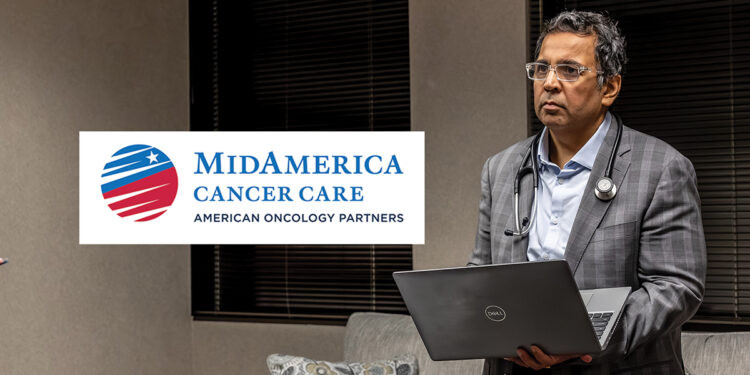
Jaswinder Singh, MD
In cancer care, geography has always been a quiet determinant of fate. Patients who live near major academic centers often have access to the latest therapies and the newest clinical trials—options that can mean months or even years of life. But for thousands of Americans living miles from those hubs, the distance between home and hope has long been measured in hours on the road, paychecks lost, and families stretched thin.
For MidAmerica Cancer Care (MACC), the Kansas City–based oncology practice founded by Dr. Jaswinder Singh, closing that distance has never been an abstract goal. It has been the work of a lifetime. And today, through a new partnership with the American Oncology Network (AON), that mission is entering its most ambitious chapter yet.
The story of MACC and AON is not a story of corporate expansion or business alignment. It is a story about what happens when conviction finds structure, and when a decades-old commitment to research is met with the resources to elevate it. It is also, fundamentally, a story about access—who gets it, who doesn’t, and how MACC has spent years rewriting that inequity.
A Childhood Lesson That Became a Lifelong Doctrine
Dr. Singh’s belief in access began long before he would know the word “oncology.” Growing up in India, he was plagued by severe asthma, the kind that left him breathless in the middle of the night and unable to join other children outside. A single medication changed that. It opened his lungs, and with it, something much larger: the recognition that medicine, delivered at the right time, could change the direction of a life.
It was the earliest seed of the philosophy that would guide him across continents and into the field of cancer care. But once he began practicing oncology in the United States, he encountered a system that did not always deliver those life-changing options equally.
Across rural America—and even in suburban pockets—patients who were technically “candidates” for clinical trials were often functionally excluded. The travel was too far. The appointments too frequent. The logistics too overwhelming. These were not decisions made by science; they were decisions made by circumstance.
“Access shouldn’t be the barrier,” Dr. Singh has often said. “If the treatment exists, the patient should have a path to reach it.”
This belief would eventually become the backbone of MidAmerica Cancer Care.
 A Practice Built Around the Future, Not the Past
When MACC opened in late 2019, it was born into a healthcare landscape in which community practices were often viewed as secondary to academic centers. But Dr. Singh and the founding clinicians believed the opposite: that community oncology could be the engine of innovation, not merely a recipient of it.
Where many practices retrofitted themselves to accommodate clinical trials, MACC designed its model around them from the beginning. Trials were not an “add-on” or a prestige marker; they were a core expression of the practice’s identity.
The early years were defined by an almost stubborn insistence on bringing research directly to patients. MACC opened clinics in accessible locations, coordinated trial navigation seamlessly with routine care, and recruited clinicians who were committed not just to treating cancer, but to advancing the science behind it. In communities that had long felt distant from research opportunities,
MACC became a bridge.
Patients who once assumed they’d have to drive hours for immunotherapy trials suddenly found those same options in clinics minutes from their homes. Families who believed experimental therapies would require time away from work or children discovered that MACC’s model allowed them to participate fully without sacrificing stability.
The approach worked. The practice grew rapidly, but the mission never changed.
The Hidden Architecture Behind Clinical Trials
Most patients experience a clinical trial as what it is on the surface: an opportunity to receive a novel treatment. But behind every trial is a complicated, highly regulated infrastructure requiring:
• Sponsor relationships
• Regulatory submissions
• Safety oversight
• Protocol coordination
• Data collection and continuous compliance
For a community practice, building and maintaining that infrastructure at scale is extraordinarily demanding. Many choose not to do it. Some try but eventually step back.
MACC did neither. It persisted—not because it was easy, but because for Dr. Singh and his team, the alternative meant turning away patients who might otherwise have options. But by 2023, as trial opportunities grew and oncology research entered a new era of immunotherapies and targeted agents, MACC faced a turning point. To continue expanding access to trials at the pace patients deserved, the practice needed a partner—not one that would dilute its mission, but one that would strengthen it.
That partner was American Oncology Network.
AON: The Infrastructure to Match the Mission
Founded in 2018, AON was built on a concept that immediately resonated with MACC: that community practices should not be forced to choose between independence and innovation.
AON provided exactly the kind of support MACC needed:
• A dedicated clinical research division
• Centralized regulatory and compliance oversight
• Relationships with national and global trial sponsors
• Data systems capable of supporting trial growth
• Operational resources spanning pharmacy, lab, IT, and logistics.
For MACC, this was not about changing who they were. It was about giving their long-held mission the foundation and reach it deserved.
Where MACC had passion, AON had infrastructure.
Where MACC had the patient relationships, AON had the scalable systems.
Where MACC had local trust, AON had national influence.
The partnership formally announced in early 2025 was not a reinvention of the MidAmerica Cancer Care vision. It was an amplification.
 What This Means for Patients: Access Without Sacrifice
The impact of the partnership is perhaps most visible in the stories of the patients who no longer have to make impossible choices.
A rural patient with metastatic disease, once told that his best chance was an immunotherapy clinical trial three hours away, is now able to enroll in a comparable study at a MACC clinic twenty minutes from his home. This allows him to continue working his job, spend time with family, and gain strength from his community.
A single mother facing an aggressive tumor type feared she would need to relocate temporarily to access a trial. Instead, she receives her investigational treatment at a clinic where she can pick up her children after school.
Access is not about convenience. It’s about fighting in the trenches, together, on the frontline. Now, the MACC and AON partnership makes that possible locally.
Accelerating the Future of Clinical Research in the Region
With AON’s support, MACC’s clinical trial program has expanded in several key areas:
More Trials, Faster Start-Up
AON’s established sponsor relationships mean MACC can open trials more quickly—sometimes months faster than would be possible for a large academic center that is bogged down in bureaucracy or a completely independent practice that does not have the resources.
Broader Portfolio
Access now extends to:
• Next-generation immunotherapies
• Bispecific antibodies
• Small molecule inhibitors
• Genomically matched precision therapies
• Increasingly, early-phase studies that were once limited to large academic centers.
Stronger Oversight
Regulatory and compliance support ensures safety, data accuracy, and trial integrity, allowing MACC clinicians to focus more fully on patient care.
Network Scale
With more than 300 providers across the U.S., AON’s national footprint ensures that MACC patients benefit from a research pipeline informed by real-time findings, broad patient diversity, and shared expertise.
In short: the partnership widens the doorway to trials that once felt out of reach.
Maintaining Identity, Expanding Possibility
One of the central questions many patients had when the partnership was announced was whether MACC would remain the practice they knew: local, relational, autonomous.
The answer is yes.
MACC retains its identity, its governance, and its patient-first philosophy. What changes is not who they are, but what they can do.
“We’re still the same clinicians our patients have always trusted,” Dr. Singh has said. “We just have more tools now—more opportunities to say yes instead of no.”
The partnership ensures that MACC’s longstanding mission does not plateau, but accelerates. It positions the practice to be not only a leader in community oncology in the Kansas City region, but a national example of what local cancer care can achieve when clinical purpose is matched with operational strength.
What Comes Next
Looking ahead, the MACC–AON collaboration is poised to deepen its research contributions. The next frontier may include the following areas of exploration:
• Expanded genomic profiling for trial matching
• Radioligand therapies for rare and resistant cancers
• AI-driven prediction models to identify trial candidates earlier
• Increasing participation in early-phase studies that could help bring pioneering investigational treatments into community-based research environments.
For Dr. Singh, the reason for this work remains as personal—and as urgent—as ever.
“Our patients deserve the very best of what cancer care can offer,” he says. “Not later. Not somewhere else. Here. Now.”
The New Standard of Community Oncology
If cancer care in America has long been defined by what was possible elsewhere, the MACC–AON partnership is redefining it by what’s possible here.
It proves that cutting-edge research does not belong exclusively to academic walls.
It demonstrates that community clinics can be engines of innovation.
And it shows that when access becomes a mission rather than a metric, the entire map of cancer care changes.
For patients across Missouri and Kansas, this partnership represents something profound:the promise that hope isn’t far away. The promise that their best chance doesn’t require leaving their community. The promise that the future of oncology is already arriving—right where they live.
For more information on Mid America Cancer Care
and American Oncology Network
visit maccsp.com and www.aoncology.com/