Walking SOMEONE Home: A Day in the Life of a Hospice Nurse
Article by Ann E. Butenas
In honor of National Nurses’ Week, we sat down with Jennifer Kent, RN Case Manager at Ascend Hospice & Palliative Care, to understand what it really means to show up for someone at the end of life.
 Jennifer Kent’s day begins before most people’s alarms go off.
By the time she has reviewed overnight updates from her on-call team, she’s already thinking of her patients: who needs her first, who is declining, who needs a medication adjustment, whose family has been up all night with questions. She builds a schedule, and then, almost without fail, she lets it go.
“You really have to learn to go with the flow,” she says with a calm laugh. “Your plans will almost always change.”
That flexibility, paired with an unshakeable steadiness, is at the heart of hospice nursing. And for Kent, who has been doing this work since 2012, it’s not just a profession. It’s a calling she recognized long before she had the credentials to answer it.
Finding Her Way to Hospice
Kent grew up watching her mother, a nurse, move through the world with compassion and purpose. But it was a more personal experience that pointed her toward end-of-life care specifically. Her older sister battled cancer at a young age, and that early encounter with serious illness left a mark, not one of fear, but of understanding.
“That experience shaped my understanding of vulnerability, strength, and the importance of truly being present for someone in their hardest moments,” she says.
As a teenager, she began volunteering with hospice. By the time she became an RN, she already knew where she belonged.
“Hospice care is deeply human,” Kent explains. “It’s about comfort, dignity, and connection at end of life. Being able to support patients and families during such an intimate and meaningful time is an honor I don’t take lightly.”
What a Day Actually Looks Like
On a typical day, Kent makes four to six home visits, each lasting anywhere from one hour to several hours, depending on what her patients need. She assesses conditions, manages symptoms, coordinates medications and equipment, and adjusts care plans alongside Ascends interdisciplinary team, which includes a social worker, chaplain, LPN, and home health aide.
“We care for the whole person,” she says, “not just their physical needs, but their emotional and spiritual wellbeing as well.”
Communication is constant. She’s in touch with physicians, the medical director, families, and her teammates throughout the day. Her most critical patients are always seen first. But she’s quick to point out that some of the most important moments in her role aren’t clinical at all.
“Sometimes the most meaningful part isn’t medical. It’s holding space for someone, offering comfort, and making sure they don’t feel alone.”
A Moment That Defines It All
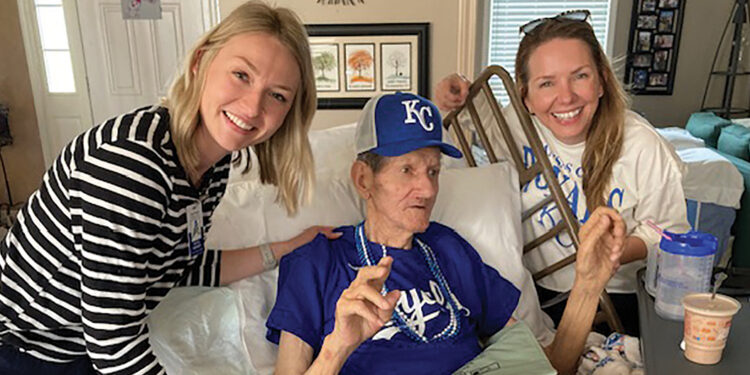
Ask Kent to describe what hospice care means to her, and she’ll tell you about a man she cared for just last year.
He had been hospitalized as his condition declined, and his greatest wish was simple: to go home. To the Ascend team, that meant making it happen and making it count.
“We got him there just in time for the Royals home opener,” she recalls. “We met him with hot dogs, beer, popcorn, Royals gear, and his family and closest friends.”
The man sat on his couch next to his son and best friend and watched the game one last time.
“It was such a simple request, but it meant the world to him and his family. It meant the world to me.”
That story, quite, specific, and unmistakably human, is what Kent means when she says hospice is about honoring a person’s life all the way to the end.
What Patients Have Taught Her
Fourteen years of this work have shaped Kent in ways that extend far beyond her professional life. “My patients have taught me to love more deeply, to slow down, and to truly appreciate the simple things,” she says. “They’ve reminded me that the most important things in life aren’t tangible. It’s not about possessions or achievements. It’s about relationships, connection, and love. ”She pauses. “They’ve made me a better daughter, sister, wife, mother, and friend.”
Changing the Conversation Around Hospice
One of Kent’s strongest convictions is that the word “hospice” carries an unfair stigma, one she wishes she could dismantle.
“Hospice isn’t about giving up,” she says firmly. “It’s about acceptance. It’s about choosing how you want your final chapter to look.”
She points out that hospice is a benefit most Americans have paid into throughout their working lives, yet many access it far too late, or not at all, because of fear or misunderstanding.
“If anything, I wish we could rename it,” she admits. “Because it represents comfort, support, and quality of life. Not fear or finality.”
She’s seen patients on hospice for just days. Others have received that care for months or years. “Hospice isn’t about shortening life,” she says. “It’s about enhancing the time that remains.”
Keeping the Cup Full
For someone who gives so much, sustainability matters. Kent is intentional about rest: yoga, time outdoors with her dog, and above all, her kids.
“Those moments refill my cup,” she says.
And when she’s running low? The work itself has a way of meeting her.
“Just when I feel like I’ve reached my limit, the universe seems to place a special patient or family in my path who reminds me exactly why I chose this work.”
That’s the quiet miracle of hospice nursing, a field built on loss that somehow, consistently, gives back.

For more information on Ascend Hospice & Palliative Care and their services please call 913-287-5678 or visit https://ascendhealth.com/hospice-care/