Walking Again Tomorrow
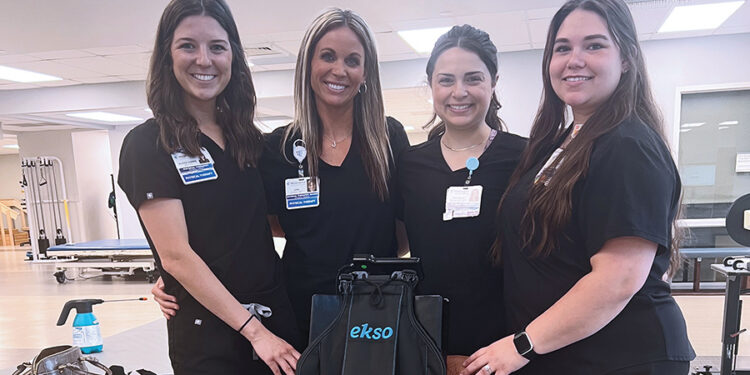
Article by Ann E. Butenas
MidAmerica Rehabilitation Hospital’s state-of-the-art Ekso exoskeleton is rewriting the recovery story for patients with stroke, spinal cord injury, and brain injury.
Imagine being told you may never walk again, and then, weeks later, feeling the floor beneath your feet, one powered step at a time. That is happening every day at MidAmerica Rehabilitation Hospital in Overland Park, where a remarkable piece of technology is changing what recovery looks like for patients facing some of the most difficult neurological diagnoses in medicine.
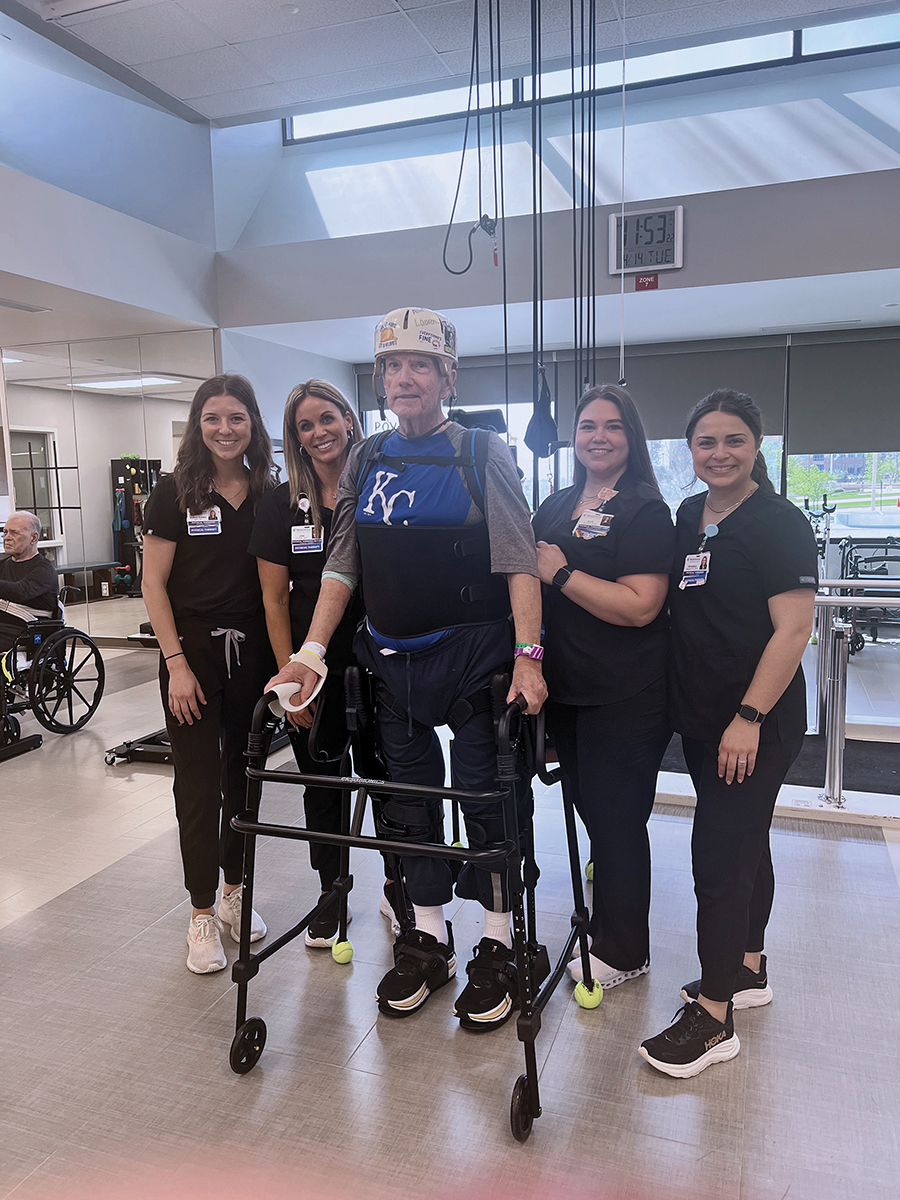
The Ekso robotic exoskeleton, a wearable, motorized suit that helps patients relearn the mechanics of upright walking, has been part of MidAmerica’s program since 2018, initially serving both inpatient and outpatient populations. When the outpatient program ended, the Ekso stayed on as a key part of inpatient care, and in January 2026, the hospital took things further. The upgrade to the Ekso NR with GaitCoach+ added new capabilities and brought four more therapists into the certified fold.
 What Is the Ekso?
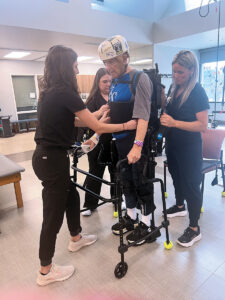
For those unfamiliar with the technology, the Ekso is an FDA-cleared bionic suit with motorized joints at the hips and knees. Originally built for patients with spinal cord injuries, it is now FDA-approved for stroke survivors, individuals with acquired brain injury, and those living with multiple sclerosis. It holds patients upright and moves them through natural walking patterns, providing a level of gait training that traditional therapy methods cannot match on their own.
The Ekso NR’s newest feature, GaitCoach+, is a software platform that tracks a patient’s walking in real time and gives therapists immediate, specific guidance on what to address.
“GaitCoach takes the guessing out of ambulation training,” said Joni Cook, PT, DPT, CSRS, Senior Physical Therapist and Stroke Care Team Lead at MidAmerica Rehabilitation Hospital. “It is user friendly and tells you exactly what the patient needs to work on. It gives us alerts for lateral shifting, leaning forward, push-off, step length, step symmetry, and swing time.”
The device does not just walk patients through the motions. It helps their nervous systems remember how.
Rigorous Training, Remarkable Results
Becoming certified to use the Ekso takes real commitment. Therapists complete online learning modules, a three-hour remote 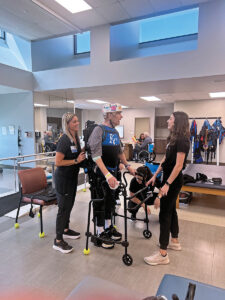 instruction session, and a three-day in-person course with a certified Ekso trainer before ever working with a patient.
That preparation shows up in how each session starts. The therapy team measures every patient before anything else, hip dimensions, upper and lower leg length, range of motion, dialing in the device to fit that specific person.
“The Ekso is very patient specific,” Cook explained. “Before a patient can get in the exoskeleton, we have to take hip measurements, upper leg length measurements, lower leg length measurements, and make sure the patient has appropriate range of motion.”
Once the fit is right and the device is powered up, patients work through standing, weight-shifting, and for many, steps they have not taken in weeks or months.
Starting Early, Pushing Further
At MidAmerica, the team gets the Ekso involved early, and Cook is direct about why.
“As soon as possible,” Cook said, when asked about timing. “Early mobilization and upright walking are best to start as soon as possible and to get as many treatments in before they leave to increase carryover and promote opportunities to ambulate.”
The brain and body respond best to repetition and challenge early in recovery. The Ekso delivers both, letting patients practice 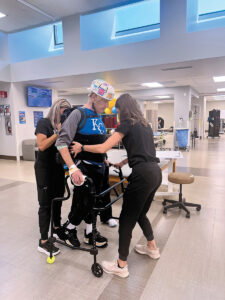 correct walking form more often and more safely than manual therapy alone allows. Built-in safety features also take physical strain off the therapist, so clinicians can stay focused on the patient rather than the mechanics of keeping them upright.
More Than Movement
The benefits of working with the Ekso go well beyond walking. Cook and her team have seen patients make gains across a range of physical therapy goals. “The Ekso can address physical therapy goals related to standing upright tolerance, weight-shifting, increased muscle activation, balance, and midline awareness,” she noted.
Research points to additional benefits for patients using robotic exoskeletons, and Cook has seen them play out at MidAmerica. “I have personally noticed changes in muscle spasticity, reduced pain, and improved overall mood,” she said.
For patients whose diagnosis once made walking feel impossible, getting back on their feet changes more than just their physical condition.
“Patients get excited to be up and walking,” Cook said, “especially if they have a diagnosis that prevents them from ever being able to walk again, like a spinal cord injury.”
A Moment That Says It All
Nothing captures what the Ekso does better than the people who use it. Cook recalled a young patient who had survived multiple strokes and was told he would never walk again. He had minimal use of both arms and legs and faced serious medical complications, but his goal stayed the same: he wanted to walk.
Cook got him into the Ekso and guided him to a standing position. He took a few steps.
“He just lit up and had tears of joy,” Cook recalled.
It goes beyond technology. It is about hope, hard work, and what becomes possible when the right tools meet the right people.
Who Qualifies?
The Ekso is FDA-cleared for stroke, acquired brain injury, spinal cord injury, and multiple sclerosis, and is also used for patients with other forms of gait dysfunction who meet the criteria. To qualify, patients must weigh under 220 pounds, have a standing hip width of 18 inches or less, have functional use of at least two extremities, near-normal range of motion in the hips, knees, and ankles without contractures, minimal leg length discrepancy, the ability to tolerate 15 minutes of standing with a supportive device, the ability to communicate with the therapy team, and a stable spine with no fractures.
Cook and her team look at each patient carefully before bringing the Ekso into their care plan. The program at MidAmerica is currently available to inpatients. Families wondering whether a loved one might be a good fit should talk to their physician about a referral to MidAmerica Rehabilitation Hospital, or reach out to the therapy team directly.
A New Definition of Recovery
What the Ekso represents goes beyond any single device or hospital program. Diagnoses that once felt like a final answer are increasingly becoming a starting point, and MidAmerica is at the front of that shift.
For the therapists who suit patients up each day and watch them do things they were told they never would again, it is a reminder of exactly why this work matters.
“Having the Ekso gives us one more technological advancement in helping our patients get up and walking again,” Cook said.
In rehabilitation medicine, that next step, quite literally, can change everything.

For more information about
MidAmerica Rehabilitation Hospital’s
Ekso program, visit encompasshealth.com
or call 913.491.2479.