How to Recognize the First Signs of Parkinson’s and Take Action
Article by Parkinson’s Foundation
Noticing changes in your body can be alarming. While movement symptoms like tremors, stiffness and trouble with balance are the most noticeable when it comes to Parkinson’s disease (PD), early signs can be subtle. Recognizing the signs of Parkinson’s can lead to earlier detection and treatment, helping people access expert care sooner and live longer, more productive lives with Parkinson’s.
In this article, the Parkinson’s Foundation breaks down 10 early signs of Parkinson’s. Experiencing one sign does not mean you should worry, but if you notice more than one, consider making an appointment with your doctor.
10 Early Signs of Parkinson’s
#1 Tremor: Slight shaking in a finger, thumb, hand or chin. A tremor while at rest is a common early sign of Parkinson’s.
#2 Small handwriting: Handwriting that gets much smaller over time or crowding words together. A change in handwriting is a PD symptom called micrographia.
#3 Loss of smell: If you seem to have more trouble smelling foods like bananas, dill pickles or licorice, ask your doctor about Parkinson’s.
#4 Trouble sleeping: Thrashing around in bed or acting out dreams while deeply asleep. Sleep disorders are a Parkinson’s symptom.
#5 Trouble moving or walking: Feeling stiff in your body, arms or legs — or not swinging your arms while walking can be a sign of Parkinson’s. Some people also experience stiffness that does not go away as they move, stiffness or pain in the shoulder or hips, or feeling like their feet are “stuck to the floor.”
#6 Constipation: Daily trouble with bowel movements.
#7 A Soft or low voice: A soft voice or sounding breathy or hoarse. If you notice a change in your voice you should see your doctor about whether it could be Parkinson’s.
#8 Masked face: A serious, depressed or angry look on your face, even when you are not in a bad mood, is called facial masking.
#9 Dizziness or fainting: Do you notice that you often feel dizzy when you stand up? Feeling dizzy or fainting can be a sign of low blood pressure and can be linked to Parkinson’s.
#10 Hunching over: Not standing up as straight as you used to or stooping, leaning or slouching when you stand could be a sign of Parkinson’s.
What to Do After You Notice Early Signs
Perhaps you notice you or your loved one is experiencing several Parkinson’s symptoms. What should you do next? Keep in mind that sometimes symptoms can be caused by an injury, age or an underlying issue. However, if you have several symptoms, consider seeing your primary doctor. Ask for a referral to a neurologist, or ideally, a movement disorders specialist (a neurologist trained in movement disorders).
What should you expect from a movement disorders specialist visit? The doctor will administer a check-up and several tests in the office. After these tests, an experienced doctor can often conclude that it is Parkinson’s. Every person with Parkinson’s has a unique diagnosis story — some people are surprised to receive a diagnosis after one in-office visit, while others can take years of prior misdiagnosis.
Next Steps After A Diagnoses
A Parkinson’s diagnosis often brings a range of emotions and various stages of adjustment. Learning to cope with a diagnosis is normal. After a diagnosis try to:
Build your care team. If your symptoms interfere with daily life, find specialists who are trained in Parkinson’s. For instance, a physical therapist can address balance issues while a mental health professional can address mood changes.
Keep moving. Parkinson’s Foundation research shows that consistent exercise — at least 2.5 hours per week — can slow symptom progression. Creating a fitness routine after diagnosis is key to living well. Regular physical activity can improve many PD symptoms and offer a neuroprotective effect.
Find what works for you. Explore Parkinson.org for free resources, tools and information. Contact the Parkinson’s Foundation Helpline for help finding your nearest support group or PD specialist and answers to your PD questions at 1-800-4PD-INFO (1-800-473-4636) or Helpline@Parkinson.org.
Connect with the Heartland Parkinson’s community. Build your support team with people who understand Parkinson’s.
- The Parkinson’s Foundation Heartland Chapter can help you find local Parkinson’s-tailored events, exercise and wellness classes.
- Sign up for the Learn More. Live Better. Parkinson’s Symposium, a free educational program taking place March 24.
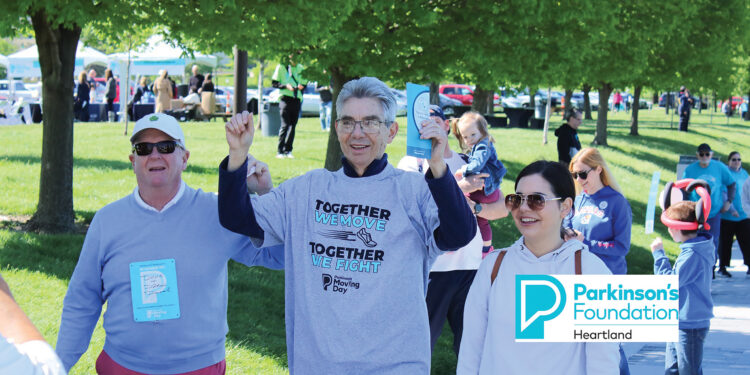
- Attend Moving Day Kansas City. Celebrate movement and community April 26th at the National WWI Museum in Kansas City.
Parkinson’s disease affects more than 1.1 million people in the U.S. Nearly 90,000 people are newly diagnosed each year. The Parkinson’s Foundation studies reveal that PD prevalence and incidence increase with age, affect men 1.5 times more than women and are higher in regions like the Rust Belt, Southern California and Florida.

Find local Parkinson’s resources and your PD community when you visit Parkinson.org/Heartland and reach out for information and support at heartland@parkinson.org