Raising Awareness for Ehlers-Danlos Syndromes and Hypermobility Spectrum Disorders in Kansas City and Beyond
Article by The Ehlers Danlos Society
Every May, communities across Kansas City and around the world come together to raise awareness of Ehlers-Danlos syndromes (EDS) and hypermobility spectrum disorders (HSD), conditions that are often misunderstood, underdiagnosed, and life-altering for those who live with them.
This year, EDS and HSD Awareness Month carries even greater meaning. In 2026, The Ehlers-Danlos Society marks ten years of global impact, a decade of advancing research, education, and care, and of building a community determined to improve lives.
But while progress has been made, many individuals and families in our own communities are still searching for answers.
Understanding EDS and HSD
The Ehlers-Danlos syndromes (EDS) are a group of 13 heritable connective tissue disorders. Connective tissue is found throughout the body and provides support, protection, and structure to organs, joints, skin, and blood vessels.
Each type of EDS has its own set of features with distinct diagnostic criteria. Some features are seen across all types of EDS, including joint hypermobility, skin hyperextensibility, and tissue fragility.
Other features are only seen in certain types of EDS and may affect different areas of the body, such as the eyes, mouth, and spine. Some types of EDS are associated with fragility of the major blood vessels or organs, which may lead to life-threatening complications.
For most types of EDS, genetic testing can be used to confirm a diagnosis when clinical diagnostic criteria are met. There is currently no genetic test for hEDS, so it is diagnosed when an adult meets the diagnostic criteria.
Hypermobility spectrum disorders (HSD) are diagnosed when a person has symptomatic joint hypermobility that cannot be explained by another condition, including EDS. People with HSD can experience many of the same symptoms as those with hEDS, including joint instability, pain, fatigue, and symptoms affecting multiple systems in the body.
The Challenge Close to Home
For many people, the journey to diagnosis is not straightforward.
It can take years, sometimes decades, to receive answers. During that time, individuals often face:
• Being dismissed or not believed
• Misdiagnosis or delayed diagnosis
• Difficulty finding knowledgeable providers
Even after diagnosis, many struggle to access coordinated care that addresses the full complexity of their condition.
These challenges are not unique to one place, they are felt in communities everywhere, including here in Kansas City. They highlight why awareness and education are so important.
A Turning Point Ahead
There is reason for hope. For the first time since 2017, the global classification criteria for all types of EDS and HSD will be updated. The new framework will be published on December 1, 2026, in The American Journal of Medical Genetics, followed by a second publication in March 2027 introducing best-practice care and management pathways.
These updates aim to help healthcare providers:
• Recognize EDS and HSD earlier
• Improve diagnostic accuracy
• Better understand how to support patients after diagnosis
This work is part of The Ehlers-Danlos Society’s global effort with the International Consortium on EDS and HSD, known as the Road to 2026, bringing together researchers, clinicians, and people with lived experience to improve diagnosis and care worldwide.
As Professor Lara Bloom, President and CEO of The Ehlers-Danlos Society, explains:
“Alongside the upcoming diagnostic update, we must also ensure healthcare systems, especially primary care providers, are equipped to recognize and support people living with these complex conditions.”
Improving diagnosis is only one part of the journey. True progress means ensuring that once someone is diagnosed, they can access the care, support, and understanding they need. This is the work ahead, and it is already underway.
Be Part of the Change
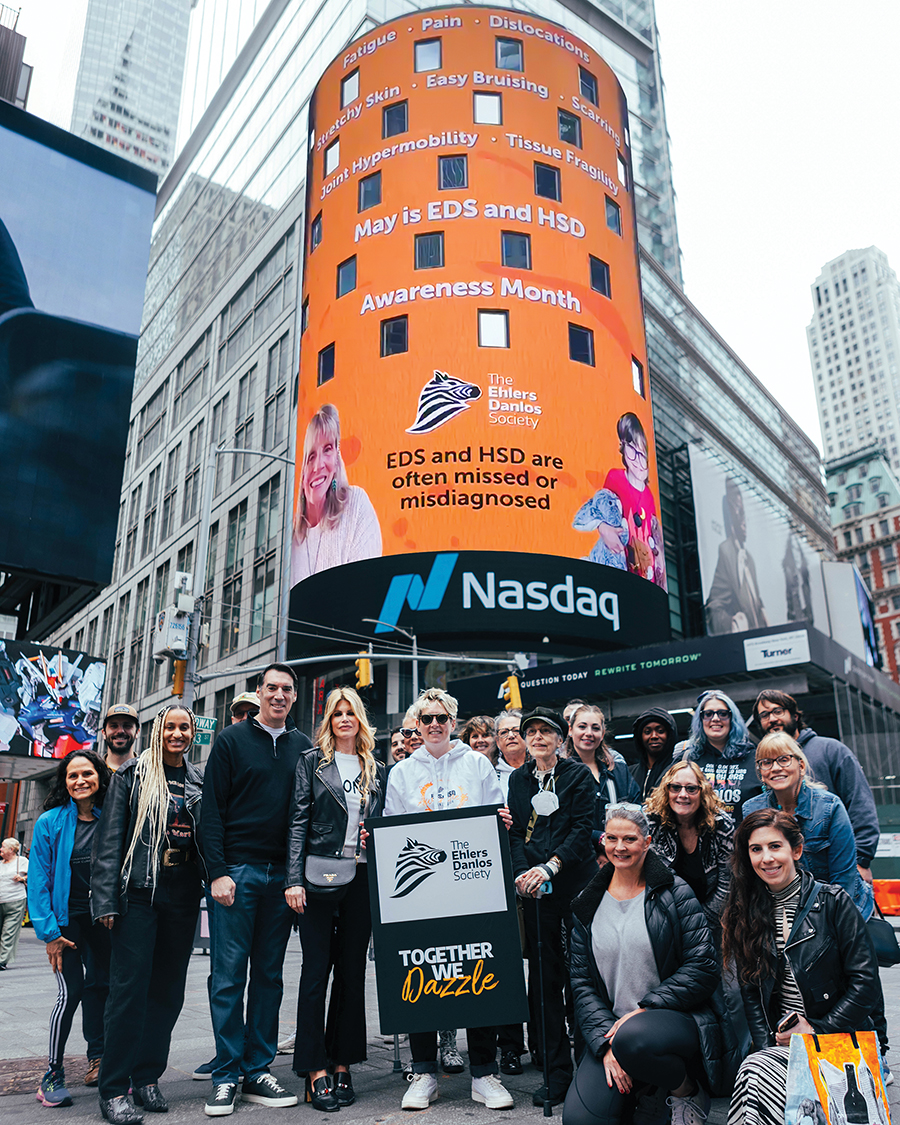
This May, you can help make a difference. Across Kansas City, individuals and families are part of a wider global movement, sharing their stories, supporting one another, and helping bring attention to conditions that too often go unrecognized.
Whether by learning more, sharing information, supporting research, or taking part in awareness activities, every action helps move progress forward. To get involved in EDS and HSD Awareness Month, visit: www.ehlers-danlos.com/may-awareness or contact giving@ehlers-danlos.com to speak with our Development Team.
Together, we’ve made meaningful progress over the past ten years, and together we can continue building a future where no one has to wait to be recognized, understood, and supported.