Changes in Knee Replacement Surgery with Jeremy Statton, MD
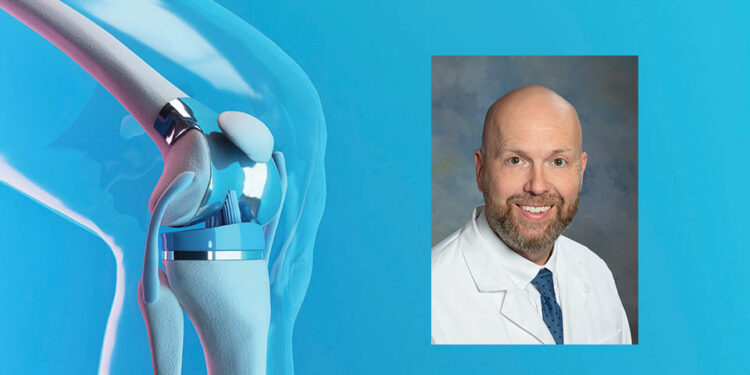
Article by Ann E. Butenas
If someone you know had a bad experience with knee replacement surgery, you’re not alone in your hesitation. Stories of long hospital stays, painful recoveries, and knees that never quite felt right have followed this procedure for decades, and understandably, those stories linger. But according to Dr. Jeremy Statton of Rockhill Orthopaedic Specialists in Lee’s Summit, the procedure has changed so significantly that comparing today’s surgery to what it was even a decade ago simply isn’t fair. From same-day discharge to a revolutionary alignment technique that restores each patient’s individual anatomy, knee replacement has entered a new era defined by faster recovery, fewer complications, and patients who are genuinely happy with their results.
Knee replacement has been around for decades. What’s changed?
So much has changed. When knee replacement was first developed in the early 1980s, surgeons were simply focused on making it work by figuring out implant design and fixation techniques. Back then, a successful surgery meant helping an older patient walk to the mailbox and back. Today, we’re far less concerned about implants wearing out or loosening from the bone. When I perform surgery now, there’s genuine reason to hope it will be the last procedure a patient ever needs on that knee.
We’ve also dramatically improved recovery and reduced complications. One of the most significant developments is same-day discharge. In the past, patients spent two to three nights in the hospital, followed by weeks in a rehab facility. That sounds thorough, but it increased the risk of infections and blood clots. Our goal now is to get patients moving immediately after surgery and home the same day. That shift alone has led to a meaningful decrease in complications.
You’re especially excited about something called kinematic alignment. What is it?
Kinematic alignment is a technique that focuses on restoring each patient’s native knee anatomy by essentially returning the knee to how it looked before osteoarthritis ever developed.
For decades, surgeons used what’s called mechanical alignment, which makes the same bone cuts for every single patient. It made surgery reproducible, but it doesn’t account for the fact that no two knees are alike. If you simply walk through a store and observe people’s knees, you’ll notice we all have different shapes and joint angles. Making identical cuts in everyone inevitably caused soft tissue imbalances in certain patients, leading to pain, instability, and dissatisfaction.
A surgeon in California reexamined this philosophy and developed kinematic alignment, which is an individualized approach that maps surgery to each patient’s specific anatomy. The goal is to decrease pain, shorten recovery, and improve long-term function.
Are you seeing a real difference in your own patients?
Absolutely. I adopted kinematic alignment over five years ago, and the improvements are significant. First, patients recover faster with less pain. Because we’re avoiding soft tissue release and protecting the soft tissue envelope of the knee, there’s less surgical trauma. Swelling and inflammation resolve more quickly. Where it once took most patients three months to return to bigger activities like sports or exercise, many of my kinematic alignment patients are more active at six weeks.
Second, knees are more stable and have better range of motion. Stiffness, which was once a common complaint, is far less frequent. Studies consistently show improved functional outcome scores with kinematic alignment compared to traditional techniques. Put simply, patients are happier.
What would you tell someone who’s been avoiding surgery out of fear?
I hear this every day. Someone knows a person whose knee replacement didn’t go well, and that story becomes a reason to keep suffering. I completely understand the hesitation, but I tell patients that we are much better at this than we were even ten years ago. The surgery has evolved. Implants last longer. Kinematic alignment improves satisfaction. It is not the same procedure it once was.
What truly saddens me is thinking about people whose quality of life is being diminished by knee osteoarthritis while they wait. We want patients to know that there are excellent options.
For more information on Dr. Jeremy Statton with
Rockhill Orthopaedic Specialists located at
120 NE Saint Luke’s Blvd., Suite 200, in Lee’s Summit
visit saintlukeskc.org/Rockhill.