Ascend Hospice & Palliative Care – Music & Massage Therapy

Article by Corinn Ayers

Kirstin Georgeson
Most people think of hospice care in terms of nurses and medication. At Ascend Hospice & Palliative Care, Director of Support Services Kirstin Georgeson is showing patients and families that those typical forms of pain management are only part of the picture.
Georgeson joined Ascend in 2021 as the organization’s first full-time music therapist. She earned her music therapy degree at the University of Kansas, and since then has completed a master’s in healthcare administration and moved into her
current role. Today she oversees a team that has grown to five full-time music therapists and seven massage therapists, along with volunteer services and bereavement care.
“Music and massage therapy are holistic, but we practice them in a clinical way,” Georgeson says. Her team works within five domains: physical, emotional, cognitive, spiritual, and end-of-life symptoms. The goal in every session is to reduce distress in one or more of those areas, and the choices behind each session are deliberate. “There is a reason we use a specific song at a specific time with a specific patient,” she says. “We do something different for everyone.”
On the physical side, therapists often work with patients who are in pain, anxious, or in respiratory distress. One technique the team uses is called the isorhythmic principle. A therapist matches the music, tempo, volume, even melodic complexity, to whatever the patient’s body is doing in that moment, then gradually shifts the music toward something calmer. Over roughly 20 minutes, the patient’s own physiological rhythm tends to follow. “Everything we do is based on research,” Georgeson says.
She described one patient in severe respiratory distress whose breathing treatments weren’t working. She started by matching her playing to his breathing, using a faster tempo, louder volume, and more complex melodies. Over the next 20 minutes she slowed it down and softened it. He went from a distress level of 10 to asleep. The team prefers live music over recordings whenever it’s an option.
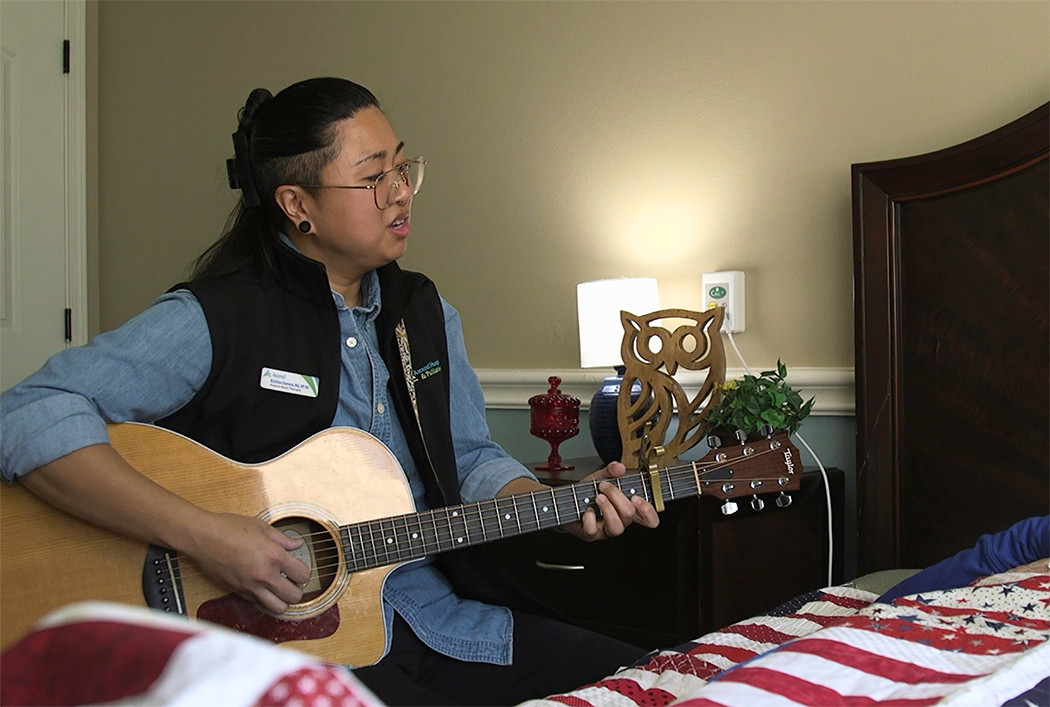
Music therapist Kristina Guevara, MA, MT-BC
The emotional side of the work can turn up things a therapist doesn’t expect. Georgeson recalled a memory care patient who could no longer speak clearly. They were singing “Home on the Range” together, and after the song ended, he kept singing. She improvised and played along, and realized he had switched to his own words, set to the same melody. He was telling her a story from earlier in his life, one he hadn’t been able to put into words any other way. “I was able to hear his memories from earlier in life when he wasn’t able to speak to me before,” she says.
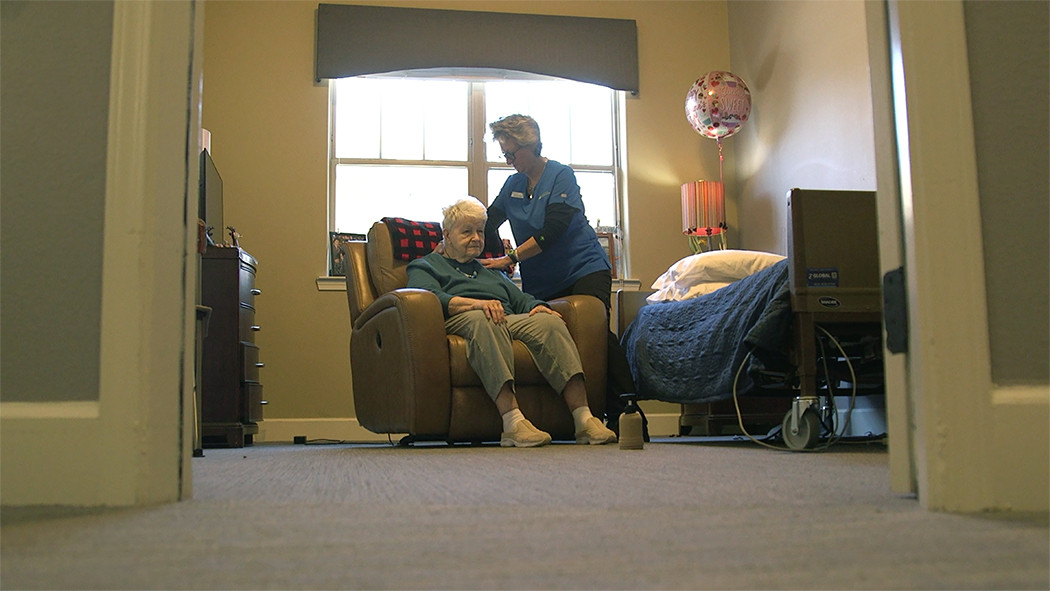
Massage therapist Kimberly Frankenfield, M.S. Ed, LMT sitting bedside with a patient
Georgeson hears two misconceptions about massage therapy come up again and again. The first is timing. People assume massage is only for the very end of life, when in reality Ascend’s therapists can work with a patient up to six months before they pass, which leaves a lot of room for music and massage to help. The second misconception shows up at the opposite end, when families become hesitant to use massage precisely because a patient is close to death.
In practice, she says, massage can bring real comfort in a patient’s final days. Muscles tense up near the end of life, which can make it harder to breathe, and massage can loosen the accessory muscles involved in breathing. Just as important, it gives families a way to connect when they don’t know how. Ascend’s therapists teach loved ones how to do a hand massage, a face massage, and how to use aromatherapy, so they can take part directly. “A lot of time, family doesn’t know how to connect with their loved one at the end of life,” Georgeson says. “It creates feelings of usefulness. They just want to help. It bridges the gap.”
She also wants people to understand what stands behind the title “Music Therapist.” To practice clinically and call it music therapy, a therapist needs at least a four-year degree from an approved program, followed by a 6- to 12-month internship, board certification, and recertification every five years. Like the rest of the care team, music and massage therapists document everything, setting their own goals, objectives, and interventions for each patient.
One thing Georgeson wanted to highlight is Ascend’s heartbeat recordings. Using a special stethoscope, a therapist records a patient’s heartbeat and sets it to a song of the family’s choosing. It becomes a keepsake, and it can help ease anticipatory grief. If the song is one the family already shares a memory around, it gives them something to hold on to.
“What we do is about so much more than managing physical symptoms,” Georgeson says. “We’re here to help care for the whole person, and their whole family.”

For more information on Ascend and their music and massage therapy programs please
visit https://ascendhealth.com/programs/music-therapy/
and Certified Expert Massage Therapy:Comfort & Relief at Home.