Home By Dinner

Article by Ann E. Butenas
Chase Hobbs, DO – A Kansas City joint replacement surgeon explains why more patients are trading a hospital bed for their own home after surgery.
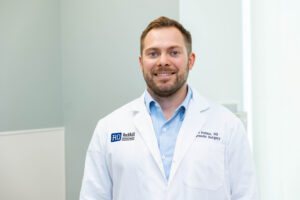 For decades, joint replacement surgery meant checking into the hospital for at least one night, sometimes more. Today, more patients are walking out the same afternoon. Chase Hobbs, DO, a fellowship-trained orthopedic surgeon with Rockhill Orthopaedic Specialists specializing in primary and complex joint replacement and reconstruction, has watched that shift unfold firsthand, and he’s helping lead it locally. A former multi-sport athlete, Dr. Hobbs says witnessing joint replacement transform patients’ lives during his medical training first drew him to the specialty and still drives him today. We sat down with Dr. Hobbs to discuss modern advancements in joint replacement surgery and why more patients are headed home for recovery.
Q: What does “same-day discharge” total joint replacement mean?
Dr. Hobbs: It means exactly what it sounds like: the same day you have your procedure, you go home. You’ll spend that night recovering in your own bed, rather than in a hospital room. Both hips and knees can be replaced this way, and the shift toward same-day discharge has been dramatic. Across Rockhill and Saint Luke’s, we adopt a “home first” commitment to discharging patients whenever it is clinically possible. Studies show recovery in a familiar setting can improve comfort, support healing, and reduce the risk of infection and readmission.
Q: What’s changed to make same-day discharge possible?
Dr. Hobbs: Modern joint replacement surgery has become far more minimally invasive, requiring less soft tissue manipulation and generating much less inflammation and pain. I also take an approach that respects each patient’s individual anatomy, restoring the joint to its pre-arthritic state rather than relying on a one-size-fits-all method. That combination allows for better pain control after surgery, meaning patients can manage recovery at home instead of needing stronger medication in the hospital.
Q: Who’s a good fit for this approach, and who isn’t?
Dr. Hobbs: Ideal candidates are healthy or relatively healthy, with few other medical conditions, a solid support system at home, and a reasonable baseline fitness level. Patients who aren’t good candidates typically have multiple medical conditions, such as heart disease, uncontrolled diabetes, COPD requiring oxygen, a history of stroke with strength deficits, severe obesity, or difficulty walking on their own before surgery. Age matters far less than most people assume. Physiological age matters more than biological age, and I’ve performed outpatient joint replacements on patients in their upper 80s. It comes down to general health and preoperative fitness, not age alone.
Q: What does the day of surgery look like?
Dr. Hobbs: Patients arrive about two hours before their scheduled surgery time for check-in and a final consultation with their surgeon and anesthesiologist. The surgery itself takes about an hour to 90 minutes. Afterward, patients spend roughly two to three hours in a recovery room eating, managing pain, and letting the anesthesia wear off. Then, they work with a physical therapist to safely walk, climb stairs and perform basic activities like getting in and out of a car. If they pass those milestones, they’re typically discharged by late morning or early afternoon.
Q: How is pain managed for a patient who goes home the same day rather than staying in the hospital?
Dr. Hobbs: Pain management strategies are similar whether you stay in the hospital or go home after surgery. In general, we start with a local injection into the joint that combines medication for pain, inflammation, and numbing. The anesthesiologist may provide the patient with a nerve block prior to the surgery. After surgery, we use multiple oral medications to limit swelling and control pain, including scheduled anti-inflammatory medications, standard pain medications, and nerve medications.
Q: What kind of support and monitoring is in place once a patient is home?
Dr. Hobbs: Patients have access to an online portal to message their care team directly, and we typically respond within a few hours. After hours, physicians and advanced practice providers are on call 24/7 for urgent questions. Patients also review warning signs to watch for before surgery, so they know exactly what’s normal and what isn’t. Given that patients are up and moving almost immediately, rather than spending long stretches in a hospital bed, we see lower rates of blood clots, lung issues, and hospital-acquired infections.
Q: What excites you the most about the future of joint replacement surgery?
Dr. Hobbs: As we continue to refine and improve surgical techniques, I believe we will see more patients who were once hesitant about joint replacement take the next step toward a better quality of life. Reduced pain can help them regain mobility and return to the activities they enjoy and may have been unable to pursue before.